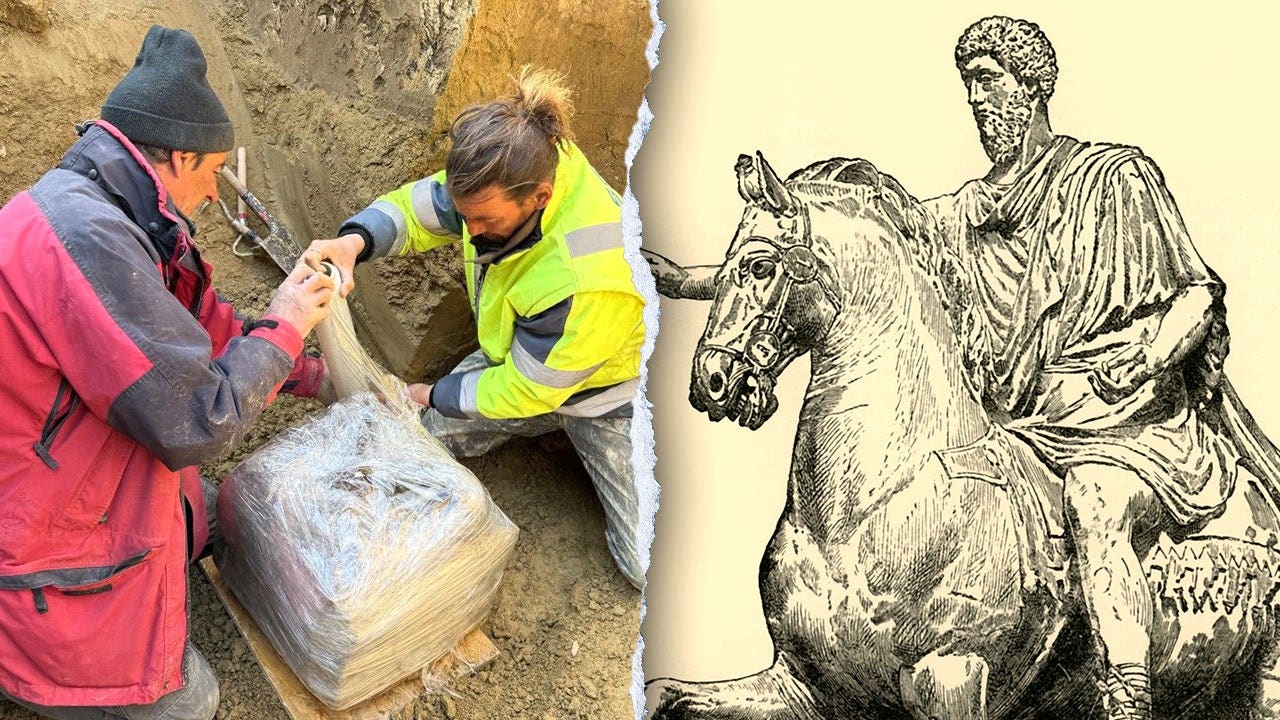
An ancient Roman military camp has been unearthed in western Slovakia, near the town of Šurany. The excavation, conducted by the Institute of Archaeology of the Slovak Academy of Sciences, uncovered the remains of soldiers, as well as their weapons and armor.
The camp dates back to the second century AD, specifically to the reign of Marcus Aurelius, a legendary Roman emperor and Stoic philosopher. It is believed to have been used during the Marcomannic Wars, a series of conflicts involving Germanic tribes along the Roman Empire's northern frontier.
The site, which covers approximately 370 acres, is significant not only for its historical importance but also for its unique layout. Unlike other Roman camps, it does not follow a typical rectangular design, but instead has an irregular shape while retaining characteristic features such as five entrance gates and fortifications.
Archaeologists have found an "extraordinary number" of human skeletal remains, including complete skeletons and scattered bones, in storage pits, wells, shallow graves, and defensive ditches. While the identities of the dead are still uncertain, preliminary findings suggest that many were Roman soldiers.
The excavation has also yielded numerous pieces of Roman military equipment, including spears, arrowheads, helmet fragments, and coins. Research at the site will continue, with officials describing the process as a "long-term scientific endeavor" that could take years to yield answers.
NTC Report coverage is based on reporting from the original publisher.
View original reporting →