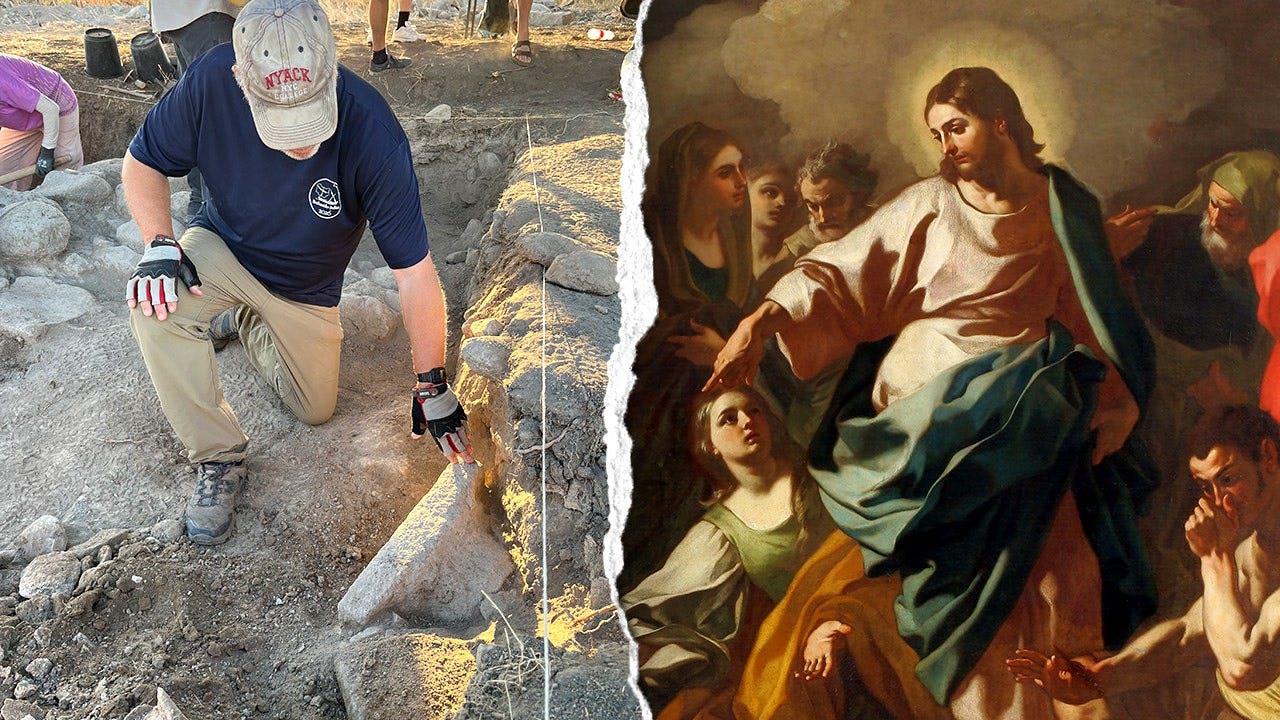
Archaeologists have identified a lost city that is believed to be tied to Jesus Christ's ministry, according to the project's academic director. The El-Araj Excavation Project, led by Mordechai Aviam, has been conducting excavations at the site along the Sea of Galilee since 2016.
The site, known as El-Araj, is located near the ancient city of Capernaum, where Jesus is said to have ministered. Researchers have uncovered evidence of an ancient Jewish fishing settlement and a Roman-era city at the site. This year's excavation has revealed additional Roman period remains and pottery, as well as over 200 coins that are being studied to help date the settlement.
The team has also uncovered Jewish stone vessels, a Roman bathhouse, and a Byzantine basilica containing an inscription linked to the Apostle Peter. According to Steven Notley, the academic director of the El-Araj Excavation Project, the site's identity as Bethsaida, the home of the apostles Peter, Andrew, and Philip, is now "100% certain." Notley, a biblical scholar and dean of religious studies at Pillar College in New Jersey, said that the case for Bethsaida has been built over years of excavation, with the accumulation of evidence from each season strengthening the identification.
The site's significance lies in its ties to Jesus, with at least one quarter of his disciples coming from Bethsaida. Notley noted that the discovery is not about finding a specific plaque or inscription that proves the site's identity, but rather about the accumulation of evidence that points to the site's history.
NTC Report coverage is based on reporting from the original publisher.
View original reporting →