
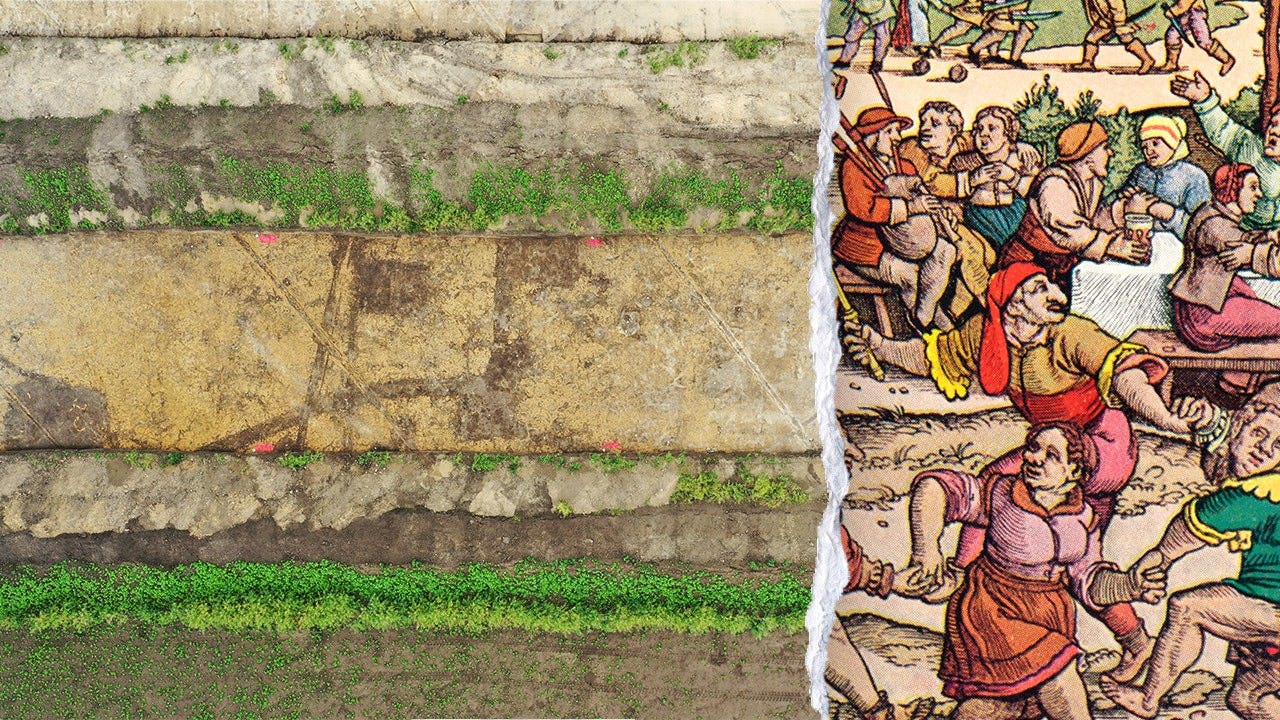
Archaeologists in Germany have uncovered the remains of a medieval village that was mysteriously abandoned, leaving behind few artifacts and raising questions about the reasons behind its departure.
The excavation at the Am Frevelgraben site in Halberstadt, in the German state of Saxony-Anhalt, revealed a multi-tiered ditch system and other signs of a medieval settlement. The State Office for Monument Preservation and Archaeology Saxony-Anhalt announced the findings on August 24.
Historical maps suggest the settlement may be the remains of a medieval village known as Kühlingen. Archaeologists documented rows of pit houses, settlement pits, and two wells at the site, indicating that the residents made extensive use of the nearby riverbank. The settlement appears to have developed in two phases, with its footprint shifting as new homes were constructed.
Despite the well-preserved remains, archaeologists found surprisingly few artifacts, including a few scattered ceramic shards and a handful of metal finds. The settlement was abandoned "in a highly orderly fashion," according to Oliver Dietrich, a spokesperson for the State Office for Heritage Management and Archaeology Saxony-Anhalt. "It was indeed striking how few artifacts were left behind," he said. "Medieval deserted villages typically yield a wealth of artifacts."
Dietrich noted that the reason behind the abandonment "remains a mystery at this time," and that further analysis will be needed to provide a precise date for the abandonment. The settlement is "clearly medieval," but researchers are not sure precisely when it was abandoned.
NTC Report coverage is based on reporting from the original publisher.
View original reporting →

