
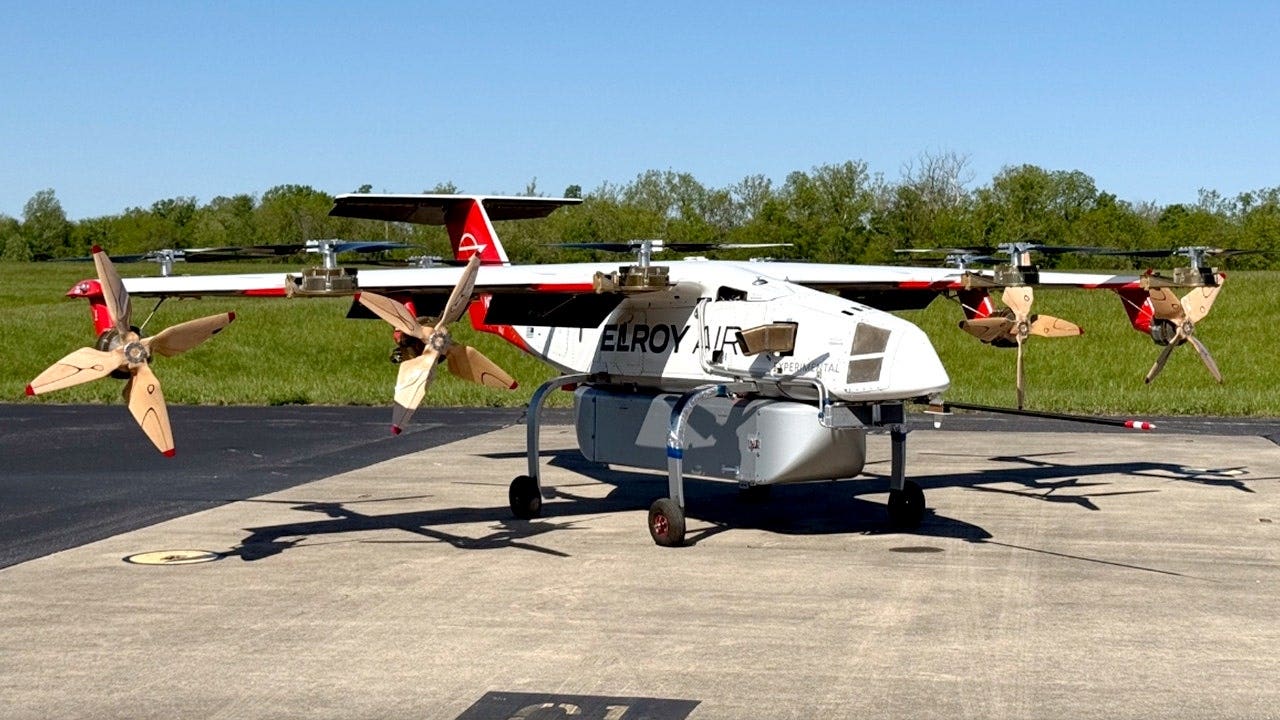
The Federal Aviation Administration (FAA) has conducted a test flight of a pilotless cargo aircraft, known as the Chaparral, at Houma-Terrebonne Airport in Louisiana. The aircraft, developed by Elroy Air, is a hybrid-electric cargo aircraft that can take off vertically and fly without a crew onboard. The test flight was part of the FAA's eVTOL Integration Pilot Program (eIPP), which aims to integrate advanced aircraft into the national airspace.
The Chaparral aircraft has a maximum range of 450 miles and a payload of over 500 pounds, making it a significant improvement over traditional delivery drones. The aircraft's cargo system is also designed to be modular, allowing workers to load and unload cargo quickly and efficiently.
The FAA is testing the Chaparral as part of its eIPP program, which includes eight projects across 26 states. The program aims to study the safe operation of advanced aircraft in the national airspace and to identify potential problems and refine procedures for advanced air mobility.
The test flight of the Chaparral is an important step towards the development of pilotless cargo aircraft, which could revolutionize the way goods are transported. The aircraft could potentially be used to move emergency supplies, industrial equipment, and other heavy cargo between remote locations.
The FAA will continue to study the test flight data and refine procedures for the safe operation of advanced aircraft. The agency will also need to determine how much human supervision is required for these aircraft and how they should respond to communication failures or other unexpected problems.
The development of pilotless cargo aircraft could have significant implications for the logistics industry, allowing companies to shorten supply routes and provide more efficient delivery services. However, the FAA will need to address safety concerns and regulatory issues before these aircraft can be used commercially.
NTC Report coverage is based on reporting from the original publisher.
View original reporting →
