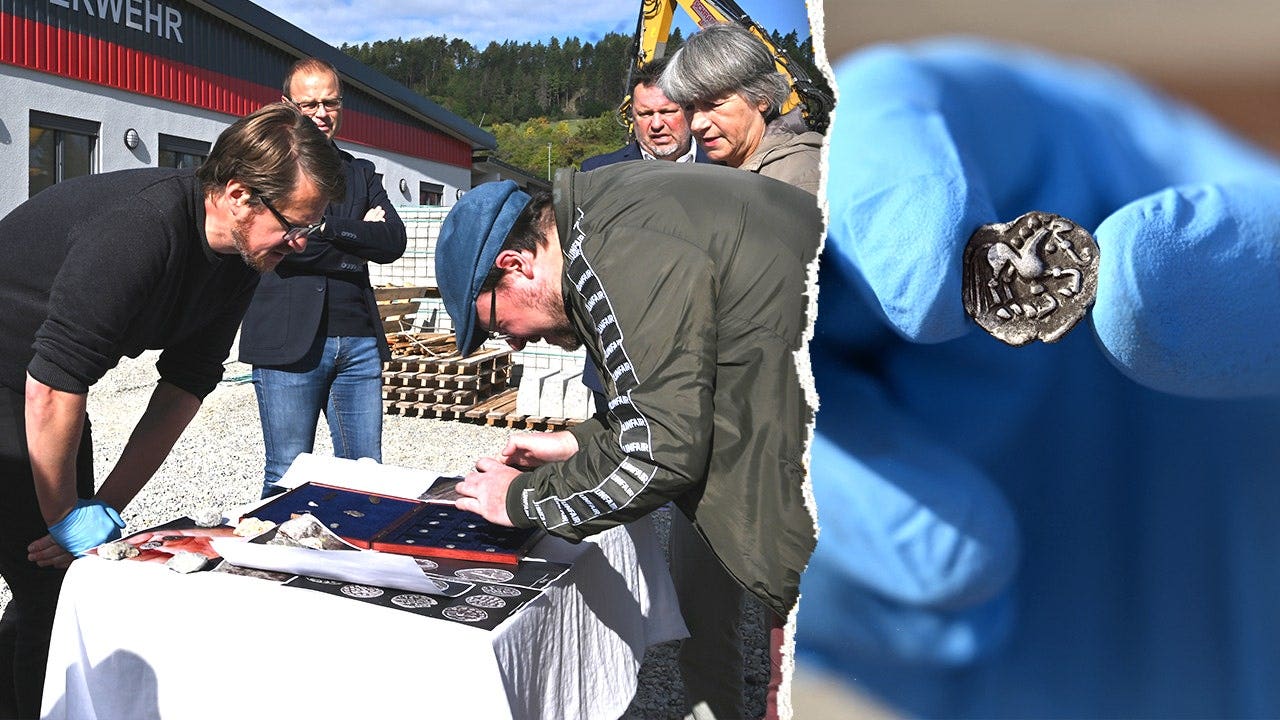
A trove of ancient coins has been unearthed at a construction site in Germany, where they had remained hidden for more than 2,000 years. The discovery was made at Singer Berg in the central German state of Thuringia, and was announced recently by the Thuringian State Office for Monument Preservation and Archaeology.
According to officials, the coins were discovered by excavation director Ronny Krause while archaeologists were investigating a former sports field ahead of the construction of a new fire station. Further excavations in August 2026 confirmed that the 11 coins dated back to the first century B.C. The coins are a type of ancient Celtic currency known as Prague-type quinarii, and represent the largest known Celtic coin hoard from that period ever found in Thuringia.
The significance of the discovery is underscored by the fact that only about 80 examples of these quinarii had been identified throughout Thuringia prior to the Singen hoard. The mint responsible for producing the coins is believed to have been located in the Gotha region, to the northwest. The Celts were groups of ancient people who lived across much of Europe during the Iron Age, and their languages and traditions survive today in places such as Ireland, Scotland and Wales.
The coins were originally buried together in a container made of organic material that has since decomposed, and were found scattered across an area measuring roughly 19 feet by 5 feet. The discovery is considered a "closed find," meaning that all the coins originally buried together were recovered. In addition to the coins, archaeologists also found an ancient Roman coin, a medieval glass bead, a knife fragment, another silver coin, and a Prussian uniform button from the 19th or 20th century.
The discovery has significantly expanded the existing knowledge of ancient trade routes and production centers, and highlights the importance of proper archaeological practices in preserving the context of discoveries.
NTC Report coverage is based on reporting from the original publisher.
View original reporting →