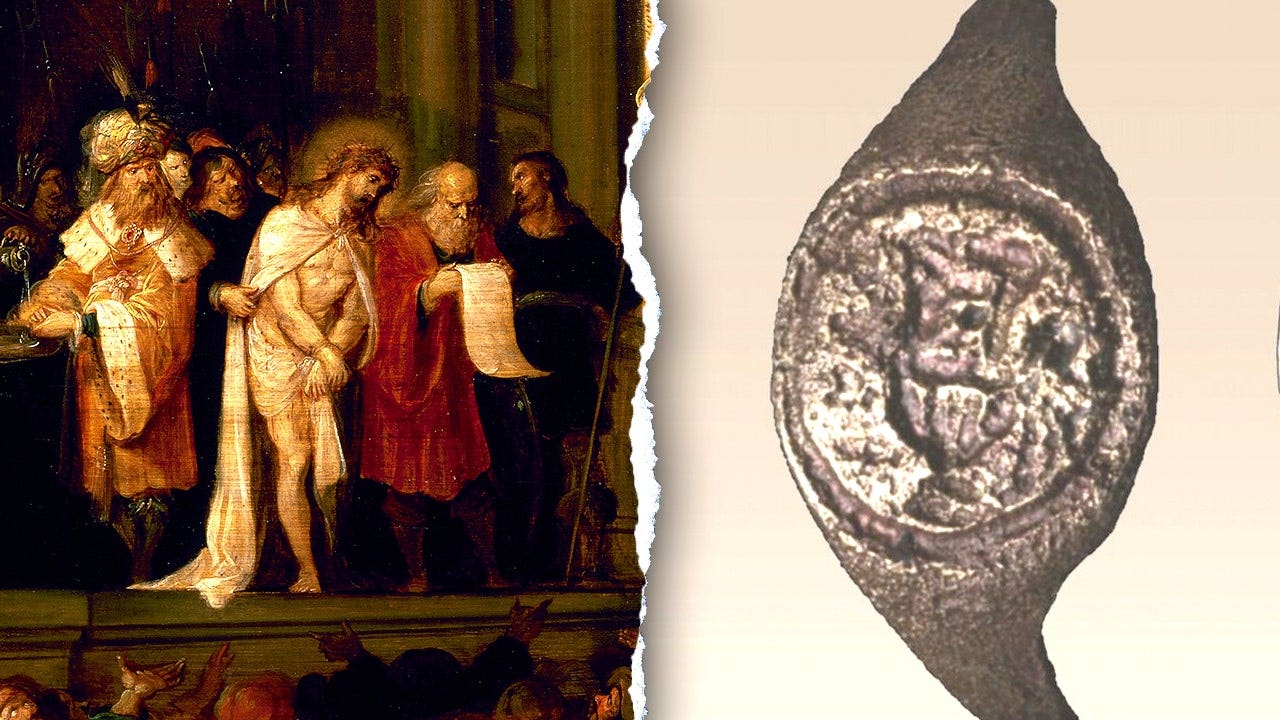
Researchers have reinterpreted an ancient ring bearing an inscription linked to Pontius Pilate, the Roman governor who sentenced Jesus Christ to death nearly 2,000 years ago. The ring, discovered in the 1960s at Herodium, a mountaintop fortress in the Judean desert, had previously been known to archaeologists but its connection to Pilate was disputed.
A new study published in the Palestine Exploration Quarterly by Catherine Bonesho, a professor of ancient Judaism at the University of California, Los Angeles (UCLA), challenges the earlier interpretation of the ring's inscription. Bonesho argues that the inscription is a transliteration of the Latin PILATO into Greek letters, meaning "for Pilate" or "to Pilate." This theory suggests that the ring did not belong to Pilate himself, but may have been worn by a lower-status worker carrying out administrative business connected to him.
The study provides new insights into the Roman administration of early Roman Judea, including how authority was distributed among lower echelons of the political structure. According to Bonesho, the ring's poor quality and Greek transliteration suggest that it was likely used by a secretary or worker who was enslaved or formerly enslaved.
Historian Candida Moss, the Edward Cadbury Professor of Theology at the University of Birmingham, believes that the new interpretation could help resolve a long-standing puzzle: why the ring is so cheaply made if it belonged to Pilate. Moss suggests that the ring may have been used by someone working under Pilate's authority, and that its use could have been a way to set a seal and show that they had the authority of Pontius Pilate and the Roman bureaucracy behind them.
The discovery may also offer new insights into the biblical account of Jesus' crucifixion, particularly the detail in the Gospel of John that Pilate wrote the inscription identifying Jesus as "King of the Jews." Moss believes that the ring may illustrate how an act carried out by a subordinate under Pilate's authority could be attributed to Pilate himself.
NTC Report coverage is based on reporting from the original publisher.
View original reporting →