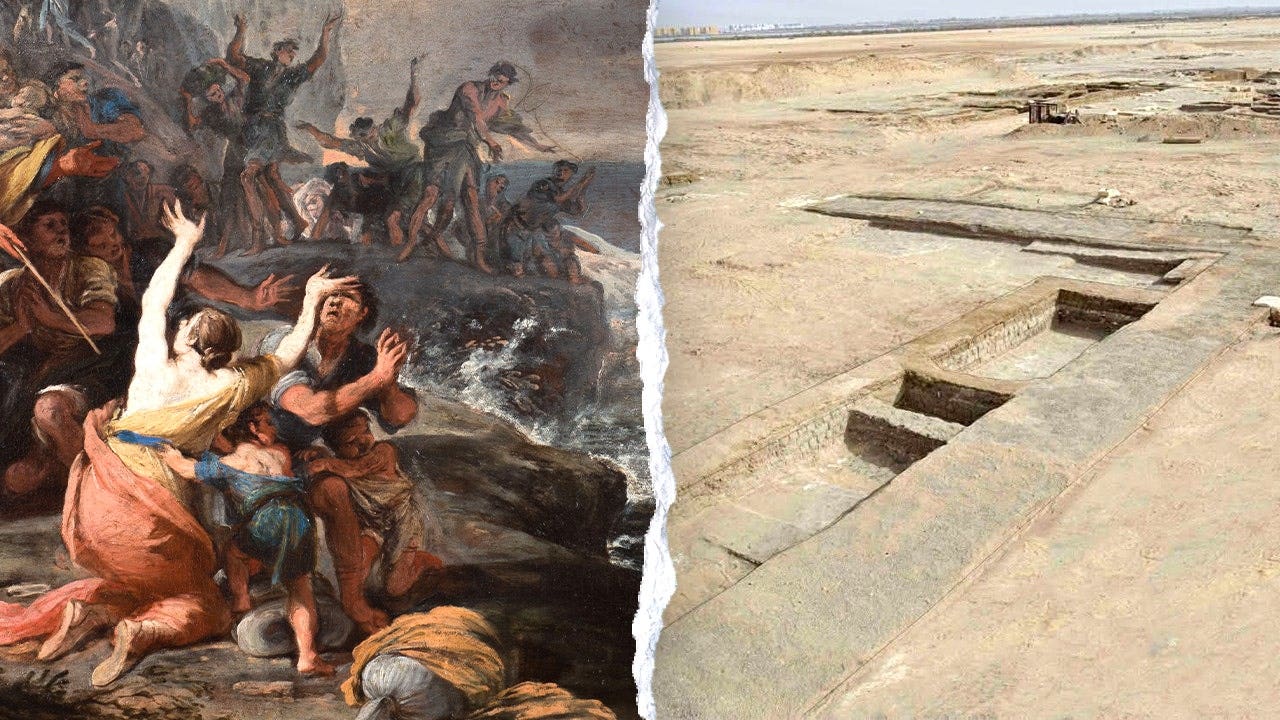
Archaeologists in Egypt have made a significant discovery that could help pinpoint a long-lost ancient city along a military route. The excavation centered on Tell Abu Seifi, an ancient fortified site in northeastern Egypt near the Sinai Peninsula.
The site is believed to be the location of Mesen, a city mentioned in texts dating back to the New Kingdom era. Archaeologists have found evidence that suggests a strong link between the site and the biblical Exodus. A massive sandstone lintel bearing the titles of Ramesses II, who ruled Egypt from around 1303 B.C. until his death in roughly 1213 B.C., has been uncovered.
The lintel also bears an inscription referring to the restoration of a statue of Horus, described as "Lord of the City of Mesen." This finding strengthens the theory that Tell Abu Seifi may be the site of Mesen. Archaeologists have also unearthed the remains of a fortified temple complex, including a mudbrick enclosure wall and gates, along with storage rooms and two ancient stone roads leading into the temple.
The discovery is one of several significant archaeological finds in Egypt this year with connections to Ramesses II and the biblical world. Officials from the Egyptian Ministry of Tourism and Antiquities have announced that the new evidence "presents a strong archaeological and historical hypothesis linking the site to the ancient Egyptian city of Mesen." However, excavation and scientific study remain ongoing in search of further evidence to definitively settle the question.
The site continued to evolve long after the temple was built, with parts of it converted into a Roman military barracks during the third century A.D. Archaeologists have also uncovered fragments of falcon statues and other sculptures.
NTC Report coverage is based on reporting from the original publisher.
View original reporting →